Electrical Engineering Technician

As automation continues to evolve across various industries, there is a growing demand for skilled professionals who can drive manufacturing and industrial transformation. Gain skills in electrical principles, industrial automation and PLC programming.

Home / Learn / Programs List / Electrical Engineering Technician
Credential
Ontario College Diploma
Duration
Four semesters
Start Date(s)
January (Winter)
September (Fall)
Locations
Belleville
Open to
International Students
Domestic Students
CIP Code
15.0303

Find your career

Loyalist’s focus on industrial automation provides the foundation for a vast array of career options: 

  • Industrial, construction/maintenance electrician 
  • Alternative energy technician 
  • Alarm systems technician 
  • Smart home technician 
  • Automation specialist 
  • Robotics technician 
  • Programmable logic controller programmer 
  • Appliance repair 
  • Heating, air conditioning and ventilation (HVAC) 
  • Electrical estimator 
  • Industrial networking specialist 
  • Electrical inspector 
  • Electrical systems and products trainer 
  • Communications systems technician 
  • Gaffer (movie/video production electrician) 
  • Railway signal technician

Our grads get great jobs

  • Electrical Designer, Bombardier Inc. 
  • Millwright/Machine Maintenance, Horizon Plastics International Inc. 
  • Construction/Maintenance Electrician, Hydro One 
  • Electrical Apprentice, Quorum International 
  • Account Manager, Torbram Electric Supply

Is it for you?

Students who thrive in this program: 

  • Like taking things apart and knowing how they work. 
  • Enjoy hands-on learning by doing. 
  • Enjoy working with computers and new technology.
How you'll learn

Experiential learning 

Receive hands-on, real-world training within a supportive learning environment that fosters personalized interactions with instructors: 

  • During your first year of study, gain a working understanding of electricity and electronics, as well as the fundamental skills needed in electrical construction and automation. 
  • Develop skills in electrical installation, motor control and the basics of industrial processes – including Programmable Logic Controllers (PLCs) and process control. 
  • Experience hands-on work with actual PLCs in your first year, not just simulation software. 
  • Gain a solid understanding of the Ontario Electrical Safety Code. 
  • A second year of study delivers skills required in installing, configuring, maintaining and calibrating industrial control systems, including industrial robotic and automated production systems. 
  • Apply your knowledge to extracurricular projects, such as building a racecar simulator arcade game using only automation equipment and software. 

Outstanding faculty make the difference 

  • Learn with dedicated instructors who come from and still work in the industry. 
  • Professors have extensive backgrounds in manufacturing, engineering, construction, technology and telecommunications in a variety of roles such as industrial and construction/maintenance electrician, lead technician, technical project manager, network engineer and corporate trainer. 

Courses

ELTP1001 Basic Electricity

Students learn the fundamental electrical principals and DC series, parallel and combination resistive, capacitive and inductive circuits. Basic AC and an introduction to three-phase power are also covered, as well as the fundamental mathematical concepts used to describe basic electricity and electronics.

ELTP1010 Basic Installation Practices

Students learn basic installation practices relating to electrical wiring systems used in residential, commercial and industrial buildings. Students use hand tools, machinery and the actual materials used in industry. Emphasis is placed on the quality of work and safe and professional working practices.

ELTP1018 Drawings, Specifications and Standards Fundamentals

Upon successful completion, the apprentice is able to interpret and use information provided from drawings, specifications and standards for electrical installation and maintenance (single-phase). The apprentice is also able to create drawings and schedules.

ELTP1005 Industrial Control

Students install electric motor control circuits using relays, contactors, starters, push buttons and other electrical control devices. This course also covers electronic and electro-mechanical sensing devices commonly used in industrial applications.

MATH1018 Technical Math 1

This math course provides skills in basic math, trigonometry, geometry, and algebra relevant to solving problems within the Electrical program.

ELTP1021 Trade Practices 1

Students will develop skills related to trade-specific safety practices and the safe use of tools and equipment commonly used in the workplace.

ELTP1007 Advanced Electricity

Students demonstrate the fundamental concepts of AC electricity in both single and three-phase applications, AC reactance and impedance, power factor, power factor correction and the analysis and troubleshooting of AC circuits. Magnetism, transformers, three-phase power and other topics related to AC systems are also included. Prerequisite: ELTP 1001, ( MATH 1014 or MATH 1018 )

CADD2006 CADD Electrical

Using AutoCAD software, the student will create basic electrical schematics, equipment layout and building construction drawings. In support of this the student will learn the basics of navigating in AutoCAD, drawing basic shapes, use of editing and productivity tools, printing and organizing of drawings. Prerequisite: ELTP 1005, ELTP 2000

ELTP2000 Codes & Installation Practices

The objective of this course is for the student to be able to demonstrate the ability to use the Canadian Electrical Code, Book I to determine proper equipment, installation and maintenance requirements for Industrial electrical equipment. The student will understand and be able to apply the relevant code pertaining to industrial Control and Automation Systems. This will include the installation of fire alarm systems, emergency Stop systems, fuses, circuit breakers, as it applies to Automation Systems. Prerequisite: ELTP 1010

COMM1066 Communications-Common Core

This course prepares students to be successful in college communication and is foundational for workplace communications.

ELTP1000 Industrial Control Electronics

Students develop an understanding of semiconductor devices such as diodes, transistors, SCRs, TRIACs and their application. Other electronic devices used in power supplies, amplifiers motor control and other industrial control equipment are also included. Prerequisite: ELTP 1001

ELTP1012 Industrial Distribution Systems

This course introduces students to industrial distribution systems, from the service entrance to the end equipment being supplied. It includes such items as service entrance equipment, metering, safety switches, wireways and busways, panelboards, switchboards, circuit breakers and fuses. Prerequisite: ELTP 1010, ELTP 1001

ELTP1020 Intro to Canadian Elect Code

Upon successful completion, the Student/Apprentice is able to navigate and apply sections of the Canadian Electrical Code (CEC).

ELTP1019 PLC Fundamentals

This course provides an overview of the programmable logic controller, PLC installation and I/O wiring procedures, general PLC programming procedures, basic PLC programming, memory basics, number systems and PLC timers, counters, arithmetic functions, number comparison function and data move functions. Prerequisite: ELTP 1001, ELTP 1005

GNED1100 Becoming a Global Changemaker

This Loyalist College graduate attributes course will help shape your perspectives, broaden your understanding of important issues affecting our societies today, and equip you with invaluable knowledge and skills that will inform your ability to influence your community in a meaningful and impactful way. By exploring topics such as cultural competency, Indigenous education, entrepreneurship, sustainability, health and wellness, and ecological literacy, you'll be equipped with a powerful toolkit that extends far beyond the classroom.

ELTP2018 Advanced PLCs

This course covers advanced use of the Programmable Logic Controllers and the necessary instructions for advanced control and communications. This course will include the Tag-Based Programming used in the ControlLogix Platform. It will also introduce students to Remote I/O and network control. The course will also cover the basics of pneumatic and hydraulic systems. Common electrical and fluid symbols, drawings and devices are also covered. Emphasis will be placed on hands-on application of learning. Prerequisite: ELTP 1006

ELTP2019 Canadian Electrical Code 2

Upon successful completion, the Student/Apprentice is able to determine code requirements and perform calculations for maximum circuit loading, continuous and non-continuous duty motor branch circuits (single motor), lighting branch circuits, electric heating branch circuits, emergency systems, fire alarm systems and fire pumps, protection and control devices, fibre optics and communication cables and equipment, service and feeders for apartments and row housing, and patient care areas.

ELTP2016 Instrumentation Systems Theory and Practical

Prerequisite: ELTP 1005, ELTP 1006, ELTP 1002

MATH2008 Technical Math 2

Students learn the basic concepts of calculus using practical applications. Includes a study of statistics required to provide information for reports and documents. Prerequisite: MATH 1018

GNED General Education Elective

ELTP2021 Adv Trade Installation Prac

This course focuses on elevating skills from basic wiring to complex industrial and commercial systems, emphasizing precision, adherence to codes (such as CEC or NEC) and specialized equipment handling for automation, security and fire alarm systems. This course will include instruction on techniques for terminating large conductors, cable tray installations and handling specialized cabling.

ELTP2020 Advanced Motor Control

This course is intended to further acquaint the student with the aspects of motor control using relay logic and to introduce them to the fundamentals of Adjustable Speed Drives, the type used in industry today. Students explore the construction, operating characteristics and connections of the alternating current type motors used in the hands-on lab experiments in the course. Upon completion of this course, the student will be better prepared to complete wiring tasks for electric motors and associated control circuit wiring using relay logic. Prerequisite: ELTP 1005

ELTP2007 Control Systems & Interfacing

Human-Machine Interfacing (HMI) technology is explored and applied in a lab setting. Students will use PC based software to develop operator screens that, along with programmable logic controllers (PLCs), are the brains behind today's production machinery and processes. Prerequisite: ELTP 1005, ELTP 2001, ELTP 2016, ELTP 2000

ELTP2008 Industrial Production Systems & Drawings

This course is intended to acquaint students with the functions of production management as it applies to maintenance. Topics covered include: the TPM system (Totally Productive Maintenance) and the basics of project management as it relates to electrical. It will cover estimating both time and materials.

ELTP2022 Instrumentation & Dig. Control

This course builds on knowledge from the previous semester. Students demonstrate how to interface Analog control into the Automation system as a whole as well as an overview of motion control concepts. Students will demonstrate knowledge with Servo Systems and the functionality and application of DC motors and AC motors. Prerequisite: ELTP 2016, ELTP 2001

GNED General Education Elective

*Courses subject to change.

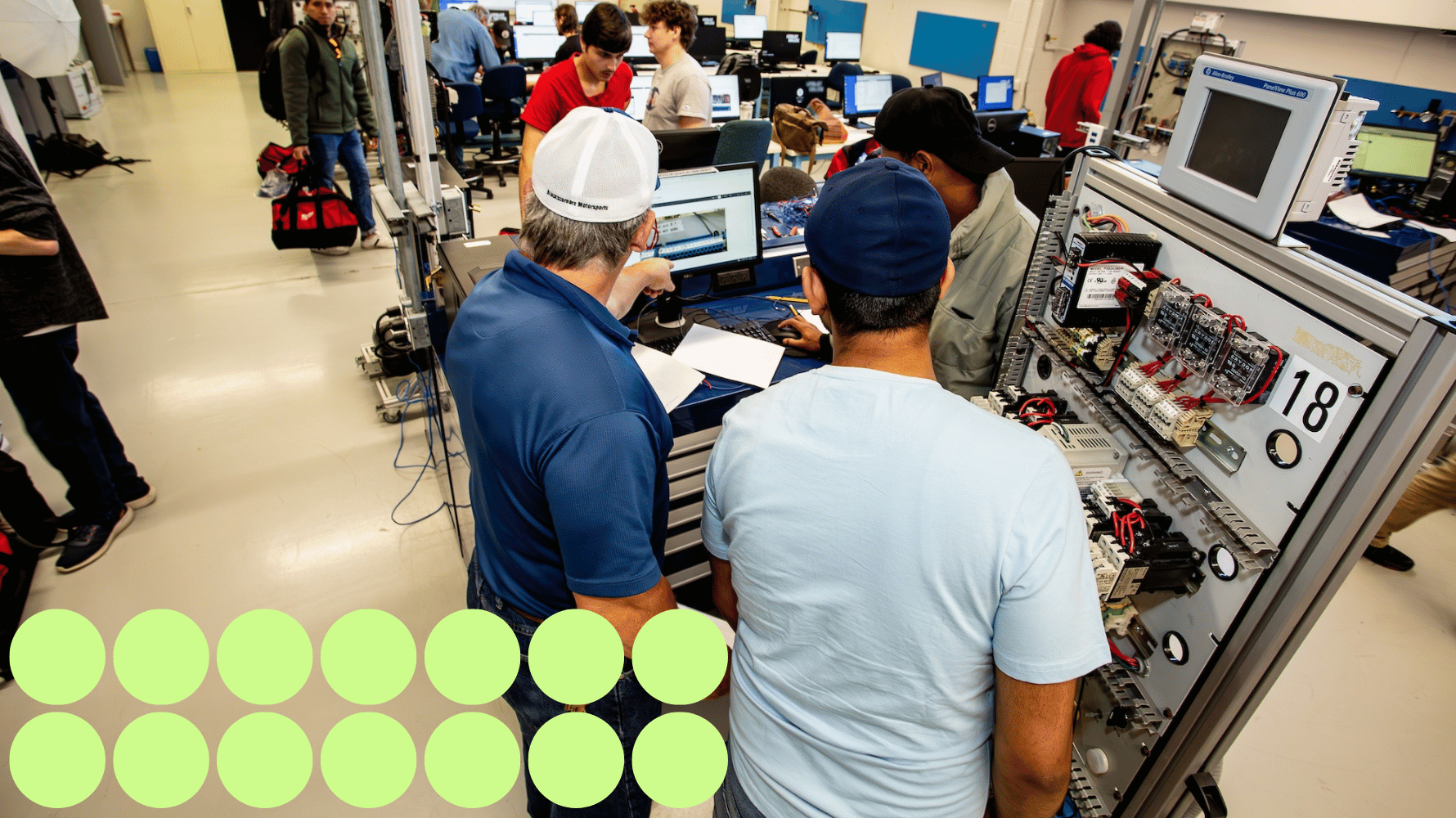
Many students in the electronics lab are working on large vertical boards and using instructions on their computers. Green graphic circles are in the lower lefthand corner of the image.

Admission requirements

Required academic preparation 

  • OSSD/OSSGD or equivalent with courses at the general, advanced, (C), (U) or (M) level, AND 
  • Grade 12 English (C) level or equivalent, AND 
  • Grade 11 Math 

OR 

Academic upgrading

Are you missing admission requirements? Discover how Career and College Prep at Loyalist can help you get started on your journey.

International students  

Learn more about admission requirements for international applicants and how to apply.

Additional requirements

*Additional materials, trainings and certifications may be required depending on industry partner requirements connected to experiential learning. Pre-placement requirements are subject to change based on placement agency and/or legislative or regulatory changes.

Costs

Approximate costs (2025 – 26, two semesters at full-time student status)* 

  • Domestic Tuition: $2,722.08 
  • Full-Time Ancillary Fees: $1,595.26 
  • Total: $4,317.34

Additional student-purchased costs may include textbooks, supplies, software, and other resources. Additional expenses related to off-campus experiential learning activities may also be incurred.


*All fees are subject to change. Fees for programs shorter or longer than two semesters will be adjusted accordingly. In addition to the costs listed above, some programs also have program ancillary fees based on their specific requirements. For a detailed breakdown of tuition and ancillary fees – including any program-specific charges – please visit the Tuition and fee schedule 2025–26.

Paying for college 

At Loyalist College, we believe that cost should never be a barrier to your success. We’re here to help you navigate the costs of college and connect you with a variety of financial aid programs, resources and donor-supported awards. Explore paying for college.

Approximate costs (2025 – 26, two semesters at full-time student status)* 

  • International Tuition: $15,900 
  • Full-Time Ancillary Fees: $1,595.26 
  • Mandatory Health Insurance: $659 
  • Total: $17,254.26

Additional student-purchased costs may include textbooks, supplies, software, and other resources. Additional expenses related to off-campus experiential learning activities may also be incurred.


*All fees are subject to change. Fees for programs shorter or longer than two semesters will be adjusted accordingly. In addition to the costs listed above, some programs also have program ancillary fees based on their specific requirements. For a detailed breakdown of tuition and ancillary fees – including any program-specific charges – please visit the Tuition and fee schedule 2025–26.

Paying for college 

At Loyalist College, we believe that cost should never be a barrier to your success. We’re here to help you navigate the costs of college and connect you with a variety of financial aid programs, resources and donor-supported awards. Explore paying for college.

Two students in the electronics lab are looking at the same computer screen. Blue graphic circles are in the lower lefthand corner of the image.

Further study

What’s next?

Graduate into the workforce – many electrical automation careers do not require an apprenticeship . 

Earn a double diploma in another college program, in as few as two semesters  

  • Electrical grads can enter Mechatronics with advanced standing and can receive a second diploma in only one more year. 

Fast track into an apprenticeship

  • The skills and experiences you gain in Loyalist’s two-year Electrical Engineering Technician – Industrial diploma program can help you jump-start your apprenticeship journey! Learn how.  
  • Information about qualification requirements leading to certification is available on the Ministry of Labour, Immigration, Training and Skills Development website. You can also contact an Employment Ontario apprenticeship office near you.

Pathways and university transfer

Build on the knowledge and skills you learned at Loyalist by continuing your academic journey. Return to Loyalist to complete a second diploma or a post-graduate program in as little as a year, or receive credit recognition for your Loyalist studies when pursuing a degree at a university. Explore pathway opportunities.

Autodesk certification

Students are eligible to take the Autodesk certification exams at Loyalist College. Completing these industry-recognized credentials enables students to highlight that they have the in-demand skills employers are seeking.