
Pulling Together: How a Classroom and Community Partnership Solved a Thorny Problem
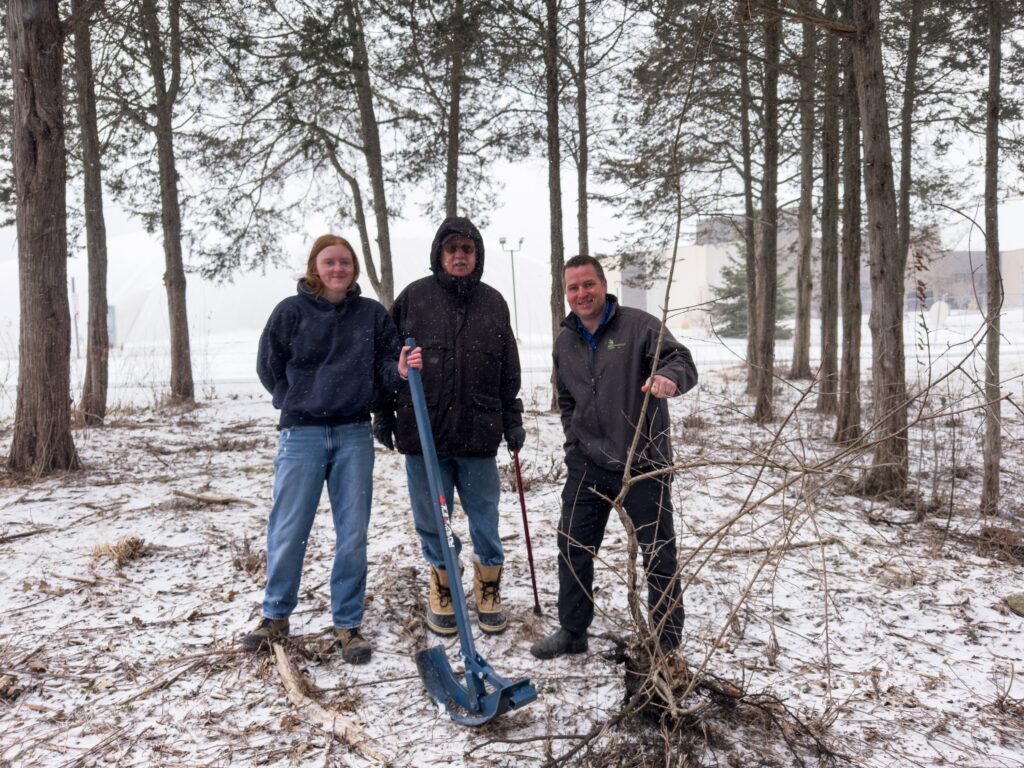
When retired teacher Peter Fisk found himself battling invasive buckthorn trees on his Prince Edward County property, he never imagined his search for a solution would lead him back to the classroom. This property maintenance challenge has since evolved into something much bigger, combining hands-on problem solving in Loyalist‘s Manufacturing Engineering Technician program with entrepreneurial opportunity and a manufacturing innovation that targets a widespread environmental issue.
“I had a thorn go under my nail and right to the bone. My finger was swollen for six weeks because the sap is poisonous,” Fisk recounts of his encounter with buckthorn, an aggressive invasive species plaguing many Ontario properties. Beyond its painful thorns and toxic sap, buckthorn aggressively displaces native plants, damages natural ecosystems, and creates dense thickets that are difficult to remove. Once established, cutting the trees down only encourages more vigorous regrowth from the remaining roots.
After being advised by his local hardware store owner that the best solution was “an old truck and some chains,” Fisk borrowed a commercial tree-pulling tool from his neighbour. While the tool worked reasonably well, Fisk immediately saw opportunities for improvement.
Real-World Learning
Through a series of community connections, including a referral from the Small Business Centre, Fisk was introduced to Jeremy Braithwaite, Program Coordinator for Loyalist’s Manufacturing Engineering Technician program.
“Peter brought the tree puller into the classroom and I assigned it to our class as a final project,” explains Braithwaite. “Each student had to come up with two improvements on the existing design.”
The design challenge became the perfect applied learning opportunity for nearly 40 manufacturing students in the program’s CAD 3 course. Braithwaite led his class outside to test the original tool on invasive species growing on the Loyalist campus, giving students firsthand experience with the product’s limitations.
“I love the experiential learning component of our courses,” says Braithwaite. “I try to involve it in all the programs that I teach in because it really helps the students dig into the project, to come up with something meaningful, to build their portfolio… and to fill a need in the community.”
Among the approximately 120 design proposals submitted, student Alicia Cannon‘s innovation stood out. Her key improvement was a curved base that revolutionized the tool’s functionality.
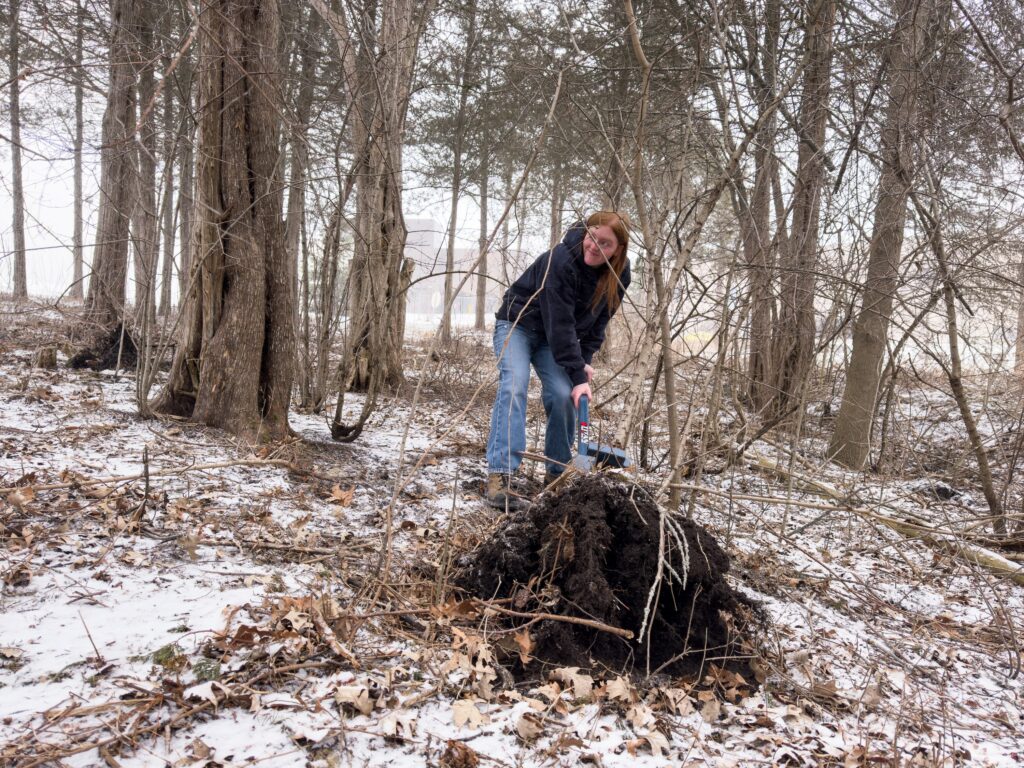
“The base was flat before,” explains Cannon. “By curving the base, it makes it so you always have leverage, it can turn with you, and then you don’t sink as much. This makes a difference, especially in the spring when the ground is wet.”
From Design to Prototype
Impressed by Cannon’s design, Fisk took the blueprints to a local manufacturer in Prince Edward County, who produced a prototype. The rebranded “Titan” tree puller has proven remarkably effective in field tests, outperforming the original tool by easily removing buckthorn stems that the commercial version couldn’t budge. Fisk notes that the prototype has successfully removed trees over four meters tall.
For Cannon, seeing her design come to life has been a significant milestone in her education. “It’s really cool to see something I designed actually get made,” she says. “This made me realize how much I enjoy CAD modelling, where I’m making continuous improvements on something. Small redesigns can make all the difference.”
Growth Potential
The tree puller has potential across multiple markets, including rental shops, groundskeepers, landscapers, and homeowners battling invasive species.
For Braithwaite, these types of community collaborations represent the best of applied learning. The project provided students with real-world design experience while meeting a genuine community need.
“There’s no wrong answer,” Braithwaite told his students when initiating the project. “What you think is a good idea, I’ll never tell you isn’t a good idea. But along the way, you have to integrate these things that we have worked on throughout the semester.”
The success of the prototype has generated interest beyond the classroom and local community. As the project evolves, conversations have begun about potential mass manufacturing opportunities that could make the Titan tree puller more widely available.
While still in preliminary stages, this next step shows how hands-on learning at Loyalist can create real solutions that benefit the college’s community.
Submit a Story Idea
Your story is part of what makes our community extraordinary. From hands-on learning innovations to life-changing partnerships, the moments that unfold at Loyalist deserve to be celebrated.
Have an inspiring achievement, classroom breakthrough, or community collaboration to share? Submit your story idea below and help us showcase how small gives us the power to do BIG things every day.
Related News

Thinking About a Career in Mental Health and Addictions Care? Here’s What You Should Know:

Thinking About a Career in the Pharmacy Field? Here’s What You Need to Know: